Premier League
The Hidden Reasons Behind Guardiola’s Departure After Changing The Game
When Pep Guardiola landed in England in the summer of 2016, the reaction was split between admiration and doubt.
His football at Barcelona had been so extraordinary, so alien in its manipulation of space and its devotion to passing. And that it reshaped global expectations. Yet, as the years passed, memory softened the shock of that era.
It became easy to forget how unprecedented that system had been. And how radical its reintroduction to English football would prove.
His tenure at Bayern Munich had drawn questions about his Champions League record. And many wondered whether his high-precision, possession-dominant style could withstand the relentless physicality, ferocious pressing, and turbulent winter conditions of the Premier League.
Those doubts only deepened in his first season. After a bright start, Manchester City faltered.
A brutal December trip to Leicester saw them concede three times inside 20 minutes and collapse 4–2 despite controlling 78% possession.
Guardiola admitted at the time, seemingly perplexed by the chaos around him. “The second ball is a concept that is typical here in England. When they talk a lot about the tackles. I am not a coach for the tackles so I don’t train the tackles.”
The conclusion was simple. Guardiola had to adapt to England. But what emerged instead was far more profound. Rather than England reshaping Pep, Pep reshaped England.
How Guardiola Rebuilt the English Game from Its Foundations
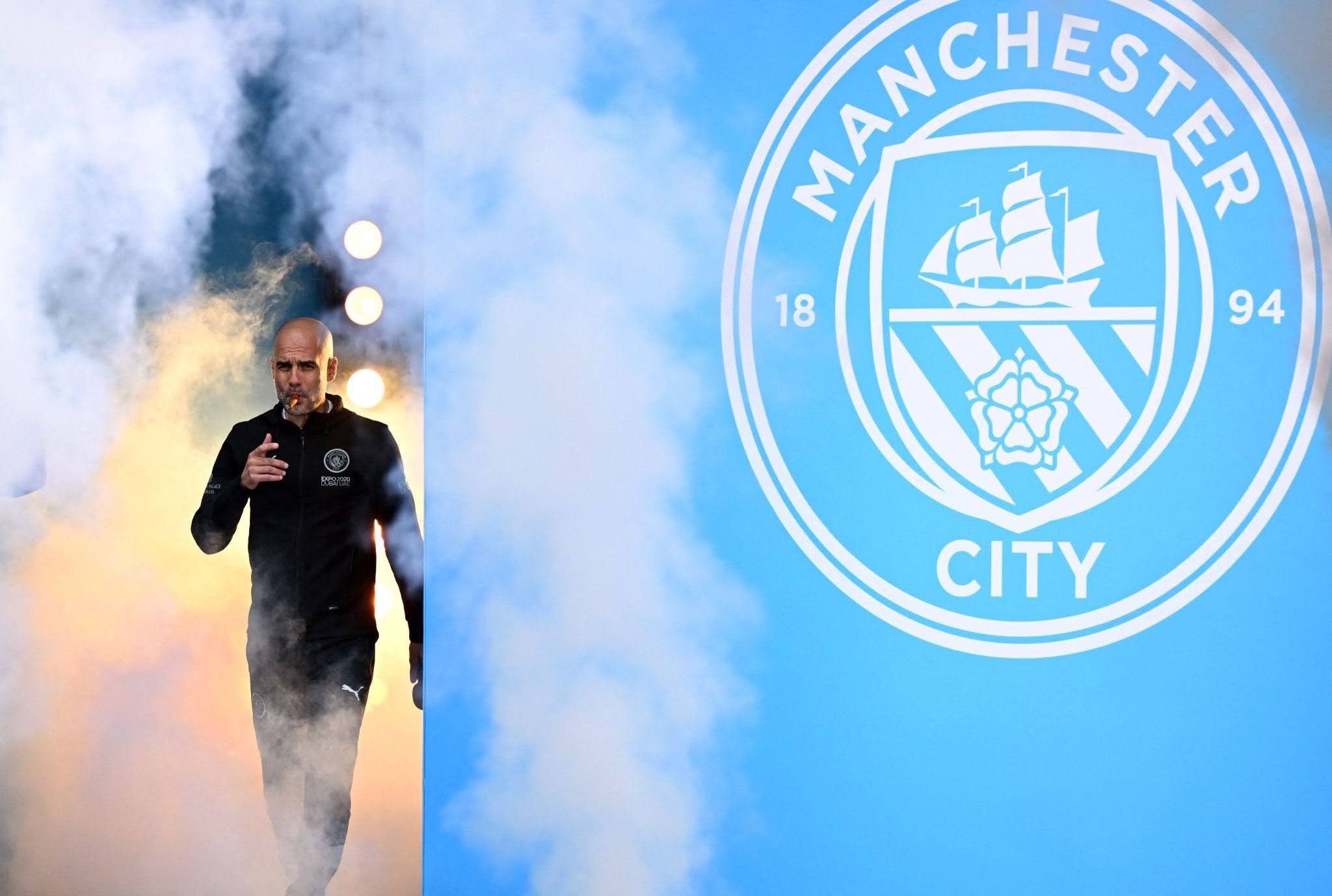
Pep Guardiola standing next to the Manchester City F.C. club crest.
To grasp the scale of Guardiola’s influence, one must look beyond the Premier League spotlight. Travel down the English pyramid to the ninth and tenth tiers once bastions of raw, direct, muddy football. And the legacy becomes unmistakable. Goalkeepers now take short goal-kicks as a default. Centre-backs split wide.
Teams insist on building from the back even on modest hybrid or 3G pitches. Coaches routinely explain that young players “just grow up playing this way.” The landscape has changed at its grassroots.
This shift aligns perfectly with Guardiola’s long-held principles. His football always relied on pitch quality, on surfaces stable enough for first touches to be automatic rather than hopeful.
As turf improved across England, players could focus less on trapping bouncing balls and more on manipulating space, creating overloads. And also constructing patterns exactly as the environment Guardiola’s ideology demands.
The Financial Context and the Structural Support
Manchester City’s transformation, of course, was fuelled by immense financial power. Without the backing of Abu Dhabi, their era of dominance might not have materialised.
And until the Premier League’s financial charges are resolved charges City firmly denies there will remain a caveat. A cloud of procedural uncertainty.
But money alone explains little about how English football as a whole shifted. The widespread adoption of Guardiola’s methods was accelerated by changes in youth development.
The Premier League’s Elite Player Performance Plan (2012) and the FA’s England DNA programme (2014). These institutional frameworks encouraged technical proficiency, positional intelligence, and passing patterns principles deeply aligned with Guardiola’s vision.
Yet none of these structural elements diminishes the core truth that Pep Guardiola fundamentally altered the tactical consciousness of English football.
A Manager in Constant Evolution
Pep Guardiola, the acclaimed football manager known for his tactical innovations.
What sets Guardiola apart from the great thinkers who came before him is not just his innovations, but his refusal to stop innovating.
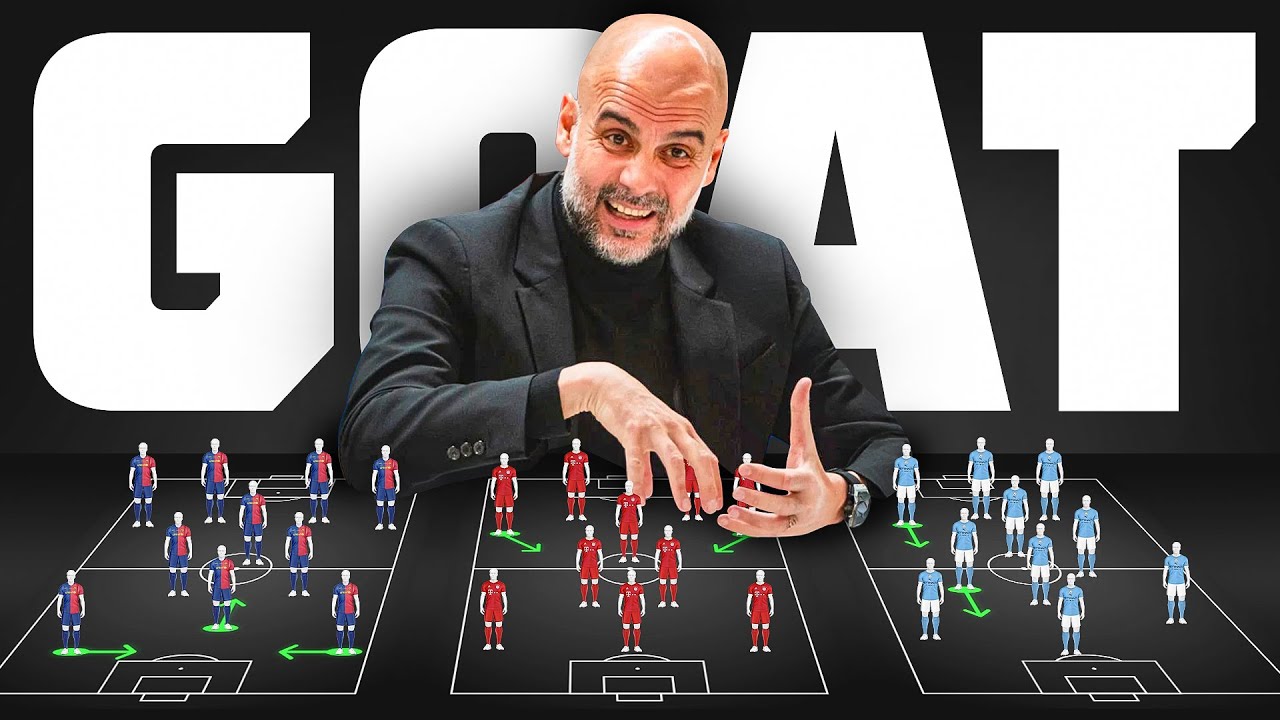
His entire Manchester City journey has been marked by tactical reinvention. The list reads like a chronology of modern football evolution.
He began with overlapping full-backs, then shifted to inverted full-backs stepping into midfield. Then full-backs became auxiliary centre-backs.
Then came John Stones stepping out as a hybrid defender-midfielder. At times he abandoned the traditional striker for a false nine, only to later embrace the most classic of centre-forwards.
He has alternated between total, suffocating control and more fluid, risk-tolerant phases built around elite 1v1 dribblers.
This constant recalibration has sometimes led to Champions League overcomplications. But it is also what has allowed him to stay at the very top for 18 years across three major leagues.
Today, intriguingly, Guardiola exits just as his own tactical dominance has loosened. English football is trending toward directness, physicality, set-play supremacy, and long throws.
But unlike other revolutionaries, Guardiola leaves not because the world moved past him. But because he mastered one cycle and stepped aside as the next began.
A Decade at Manchester City
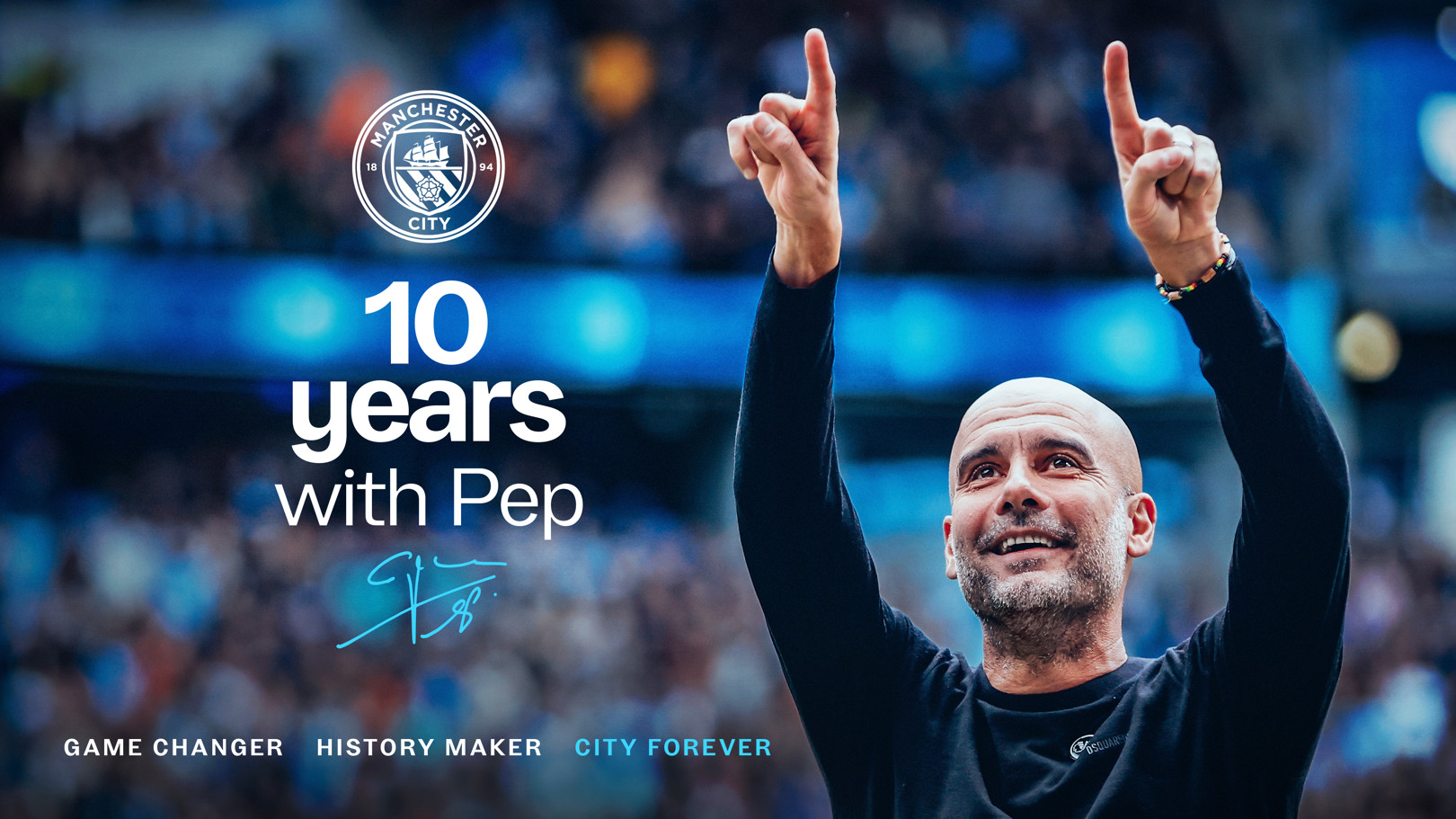
Pep Guardiola will step down from his role at the end of the season.
After a decade of unprecedented success at Manchester City, his departure was made official on Friday. Guardiola himself explained the reasoning plainly energy.
With 17 major trophies at City and 20 overall including Community Shields, he has operated under enormous pressure for nearly two decades.
He admitted, “Rest. No plans to train for a while. Otherwise, I would be here. I need to step back, I will not train for a while.”
He added, “Many people when I said it would be my last season said after three months you will come back. I don’t think so, I will take a while. But I have to prove to myself [that I need a rest].”
The workload has been relentless. Between Barcelona (2008–12), Bayern Munich (2013–16), and Manchester City (2016–24), Guardiola has lived under nonstop expectation.
As he put it, “It’s not 10 years, except half a year in New York it has been 17 or 18 years. Every three days with people demanding trebles and Premier Leagues and I need to breathe a little bit and relax. I will be out for a while.”
Pep Guardiola’s Achievement at Manchester City
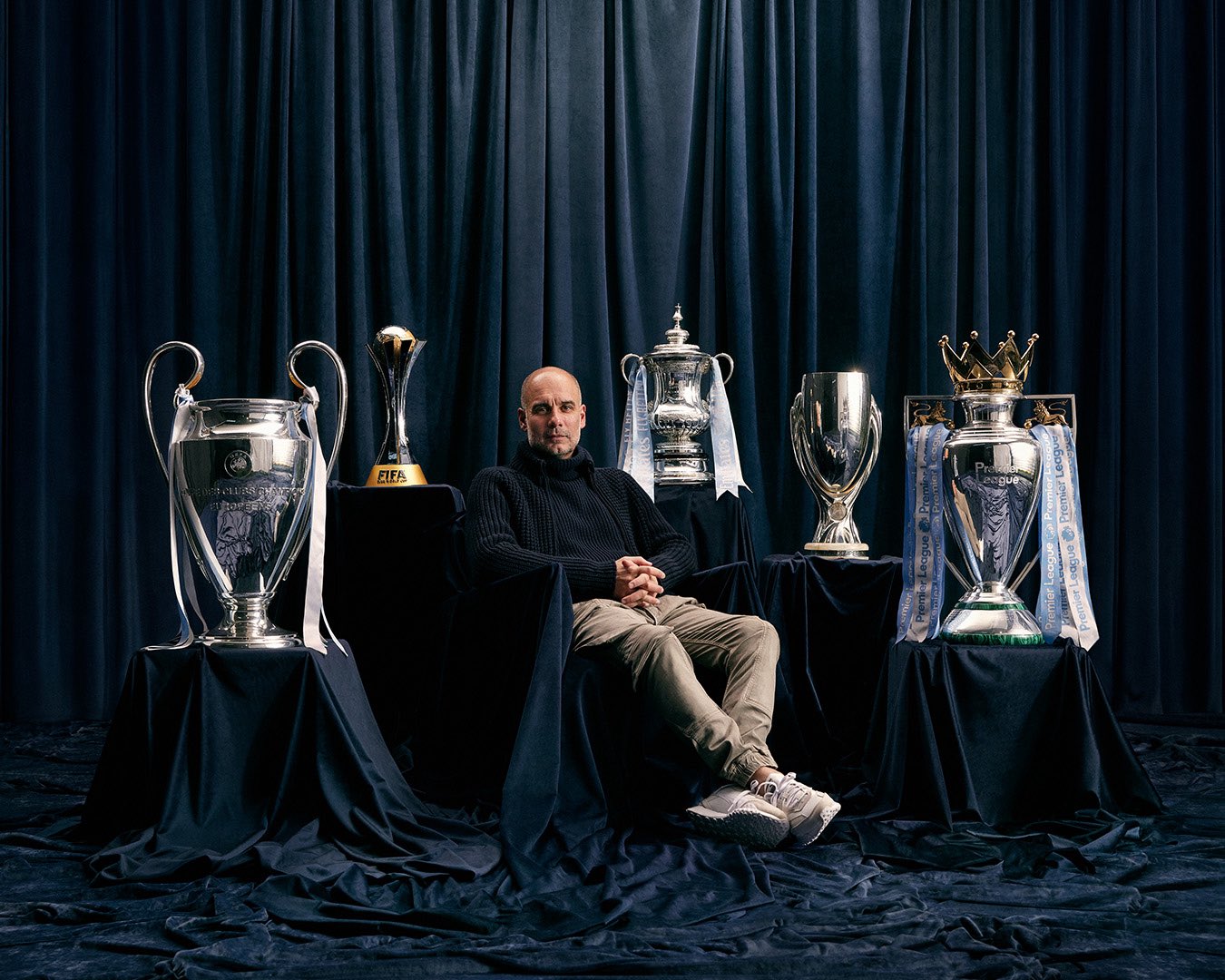
Pep Guardiola sitting alongside the historic “Big Five” trophies won by Manchester City F.C. during their historic calendar year in 2023.
His achievements at City are vast. A treble. The club’s only Champions League. A record four consecutive Premier League titles. A 100-point season. Five Carabao Cups. The list is almost absurd.
He reflected warmly on the journey.
“I feel really satisfied, happy, and proud. It has been the experience of my life at City, I would not have been 10 years old. I cannot be more grateful for the amount of love and affection.”
The city will immortalise him. The expanded North Stand will be renamed The Pep Guardiola Stand, opening for the final match of the season.
The decision moved him deeply, especially because it carries his father’s name.
“I’m speechless, no words. What can I say? Khaldoon called me this morning and said the club made that decision… My father will come on Sunday, 94 years old, to watch the game. It’s an incredible honour to have his name in this beautiful place.”
His era has been witnessed and acknowledged by giants. Sir Alex Ferguson congratulated him.
“With his Scottish accent, I struggled to understand it was a voicemail. I will call him back for sure… He is the greatest in this country. I’m so happy.”
“Don’t ask me the reasons I’m leaving. There is no reason, but deep inside I know it’s my time. Nothing is eternal.”
A Future Still Connected to the City Football Group
Although stepping away from management, Guardiola is not cutting ties with Manchester City entirely. He will take on an ambassadorial role within the City Football Group.
“I would love to continue to be part of this club… I will take zero decisions but to be part of the club if they need me to represent them… I will be there.”
After Monday’s parade, he is expected to return to Barcelona to begin the next chapter of his life.