La Liga
Why Barcelona Chose Gordon Over Rashford: The Financial Truth Behind The Transfer
Barcelona’s sudden move to sign Anthony Gordon has caught the football world off guard.
For months, speculation around the winger centred on Liverpool, with Bayern Munich also credited with strong interest. The Catalan giants, by contrast, had not been seriously linked until this week.
When news broke that they had not only entered the race. But had already agreed a fee with Newcastle United and settled personal terms with the player.
It is a move that has escalated with remarkable speed. Gordon has done his medical in Barcelona on Thursday and barring any late collapse, pen to paper will follow shortly.
A transfer that once seemed far-fetched is now a matter of hours away from completion.
Yet beneath the surprise lies a story of long-term planning and tactical flexibility. And financial precision from a club still navigating the strict constraints of La Liga’s economic rules.
A Transfer Hiding in Plain Sight
Hansi Flick’s admiration for Anthony Gordon may not have been widely known, but clues were always there.
Photographs from earlier in the season showed Flick in deep conversation with Gordon after a Champions League match between Barcelona and Newcastle.
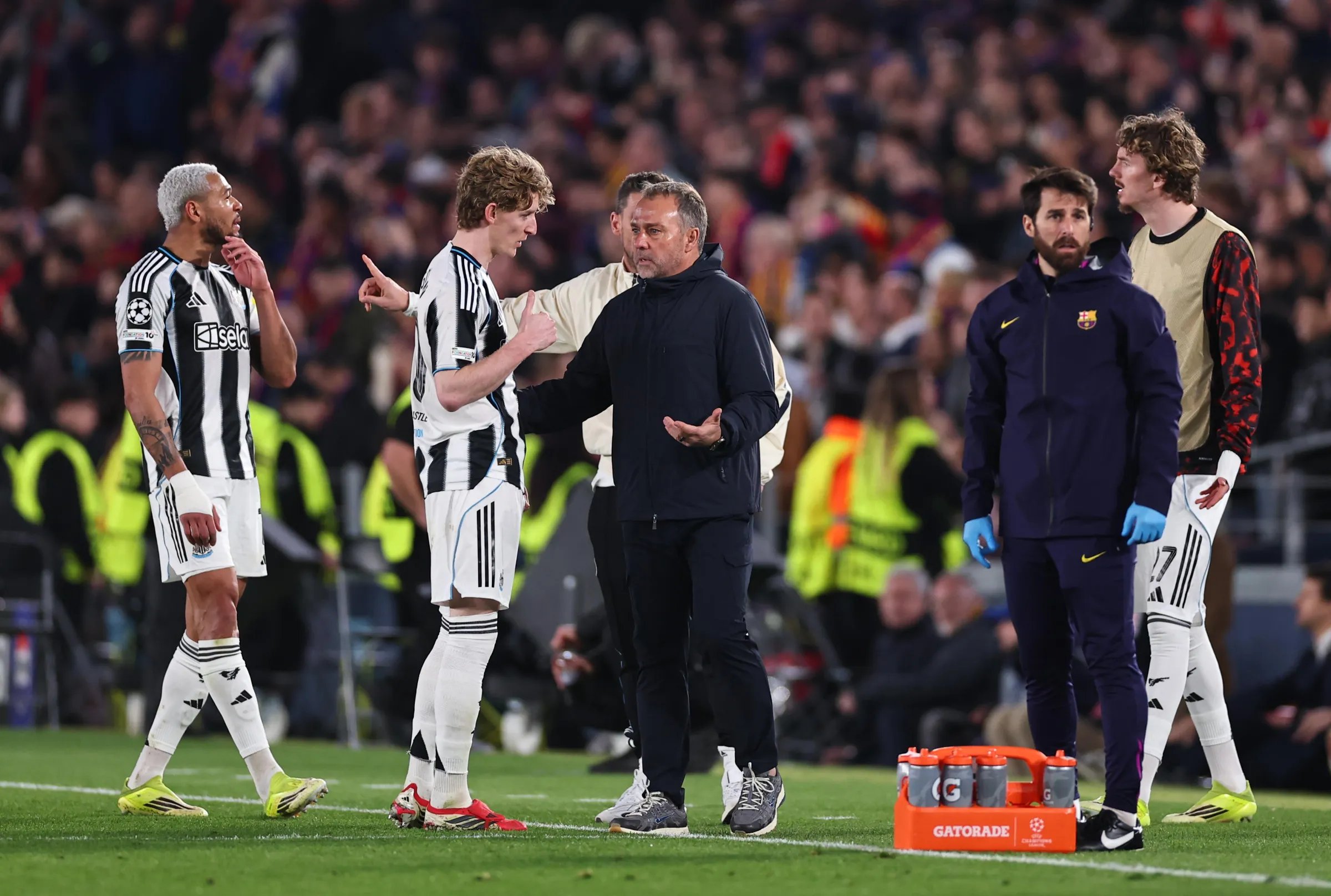
Anthony Gordon of Newcastle United speaking with Hansi Flick, the manager of FC Barcelona, on March 18, 2026.
At the time, it seemed little more than a courteous exchange. Now, it reads like the beginning of a carefully studied pursuit.
On the surface, signing a left-sided attacker appears counterintuitive. Barcelona already has Raphinha as the first choice on the left. And with Marcus Rashford assuming his situation remains unaffected capable of covering the same position.
But Flick’s vision seems to extend beyond simple positional duplication.
Gordon’s versatility makes him an attractive prospect. He has operated on the right, on the left, and centrally under Eddie Howe at Newcastle. Whether as an inverted winger, a roaming forward, or even a false-nine.
Gordon gives Barcelona a tactical weapon they currently do not possess.
A Player With High Upside but Not Without Risk
The Englishman offers explosiveness, intensity, and unpredictability. But his inconsistency has frustrated Newcastle supporters, especially during a disappointing 2025/26 Premier League campaign in which the Magpies finished 12th.
Across 26 league appearances, Gordon managed only six goals three from penalties, and two assists.
In Europe, however, he transformed into a different player entirely. Gordon scored 10 goals in 12 Champions League matches. Though five came from the penalty spot. That duality underwhelming league numbers but elite continental output creates a profile that is both exciting and uncertain.
Flick, it appears, sees Gordon as a player whose ceiling outweighs the inconsistency. With the right structure, his athletic attributes and intensity could flourish within Barcelona’s high-energy positional play.
Barcelona’s Financial Logic Behind the Deal
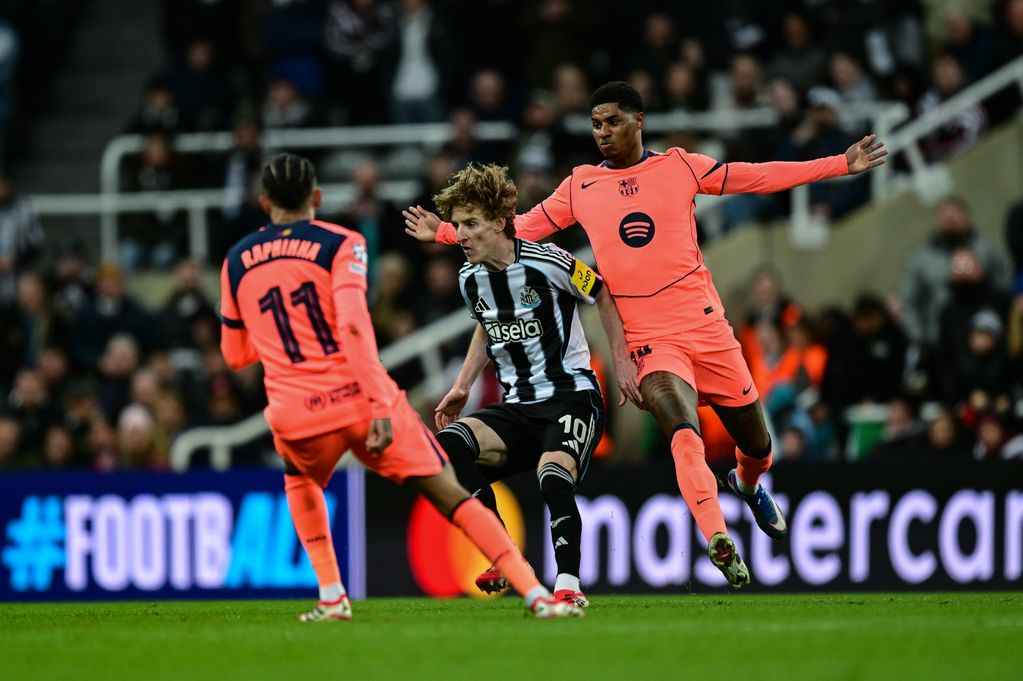
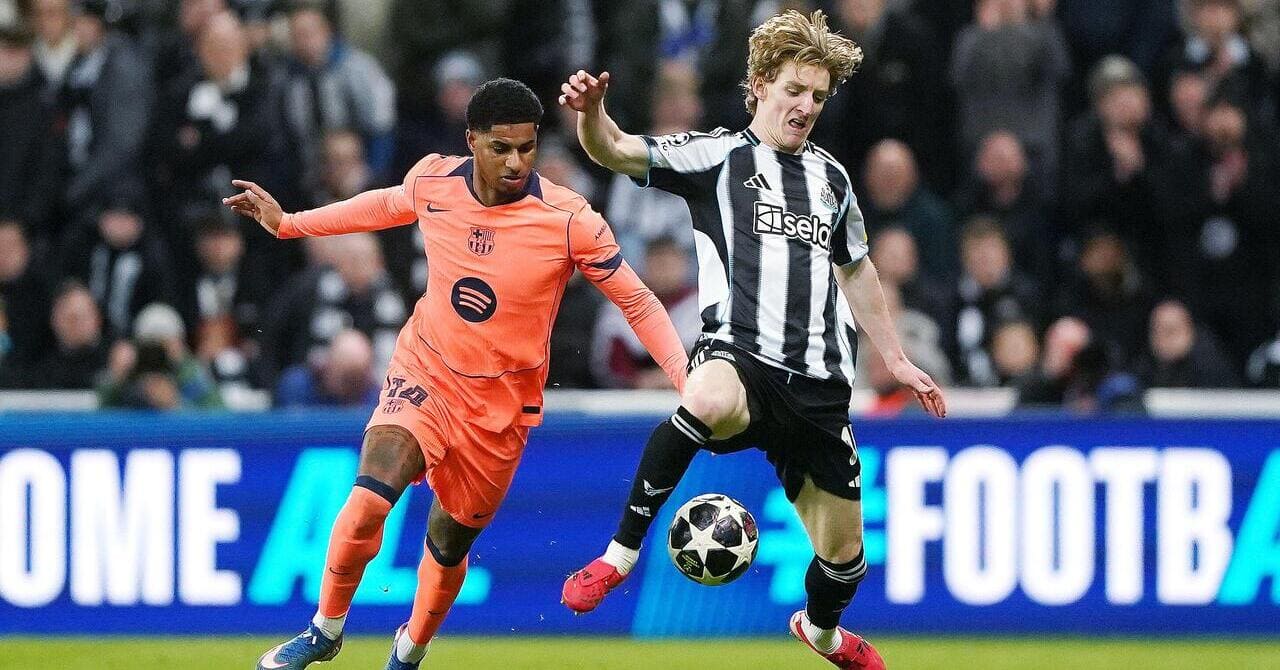
English forward Marcus Rashford (right) playing for FC Barcelona against Newcastle United winger Anthony Gordon (center) and Raphinha in front.
Barcelona’s financial reality means every major signing must pass an internal Financial Fair Play stress test. Months of calculations went into determining whether Gordon’s arrival could fit into the salary and amortisation margins required by La Liga.
The club settled on a transfer structure that makes strategic sense. Gordon’s fixed €70 million fee, spread across a five-year contract. This results in an amortization cost of roughly €14 million per season.
Add an estimated gross salary of €11 million, and his total yearly Financial Fair Play impact lands between €25 million and €26 million.
This is where the move begins to make far more sense than it initially appeared.
Barcelona had seriously evaluated Marcus Rashford as an alternative. Fans argued that if the club could pay €70 million for Gordon, they could easily pay €30 million for Rashford.
But lower transfer fees do not necessarily mean lower long-term impact. A €30 million deal for Rashford amortised over three years creates a €10 million annual cost.
Combined with his estimated €14 million salary. Rashford would occupy around €24 million per year in FFP space only slightly less than Gordon.
The decisive difference is age, upside, and resale value. Gordon is 25, entering his prime, and retains significant potential growth.
Rashford is older, has struggled with form, and carries more financial risk. Barcelona opted for the player whose long-term trend curve still points upward.
A Potential Solution at Centre Forward
Robert Lewandowski is gone. Ferran Torres could be sold this summer, with only one year left on his deal.
Without reinforcements, Barcelona risk entering the new season without a recognised striker.
Even if they manage to sign Julián Álvarez from Atlético Madrid, depth would still be thin. This opens the possibility of Gordon being used centrally in specific systems.
He played stretches of last season at centre-forward for Newcastle. Where his direct running, pressing intensity, and ability to drag defenders out of shape were highly effective.
Flick is known for his preference for fluid, interchangeable front threes. Gordon’s movement and pace perfectly complement that philosophy.
A Standout Performer in a Struggling Newcastle Side
Despite Newcastle’s underwhelming domestic season. Gordon was unquestionably their standout performer.
He finished with 17 goals and five assists across all competitions, leading the club in both categories. His 10 Champions League goals made him one of Europe’s surprise attacking stars.
Beyond output, his physical and tactical profile gives him elite upside. His work rate is relentless.
His speed with and without the ball is exceptional, making him a natural fit for counter-pressing systems. Only Harvey Barnes completed more fast breaks than Gordon’s 10 last season.
He registered 41 shots on target, trailing only Barnes, and tallied 87 total shots one of the highest figures in the squad. He converted 16 big chances with a 51.61% success rate. The best among his teammates. He also led the team with 12 shots taken from outside the box.
There are flaws his 81.8% pass completion rate lags behind the precision levels demanded at Barcelona, where many players operate in the mid-90s.
But his elite crossing accuracy 24.44%, bettered only by Sandro Tonali and Bruno Guimarães adds another dimension to his attacking toolkit.