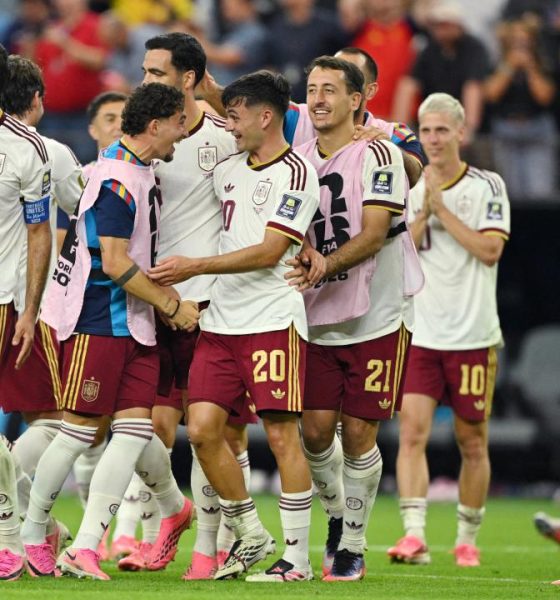
World Cup 2026
How Spain Dismantled France 2-0 And Reached The World Cup Final
France arrived in Dallas carrying the aura of tournament favourites against Spain.
Kylian Mbappe had produced moments that only world-class players can create. Ousmane Dembele had stretched defences throughout the competition, while Michael Olise emerged as one of the breakout stars of the 2026 FIFA World Cup.
Whenever Didier Deschamps’ side needed inspiration, one of those forwards usually found it.
It created a powerful narrative around Les Bleus. Their route to the semi-finals seemed driven by individual brilliance rather than collective dominance.
But football’s biggest tournaments eventually expose every weakness.
On Tuesday night, Spain exposed France.
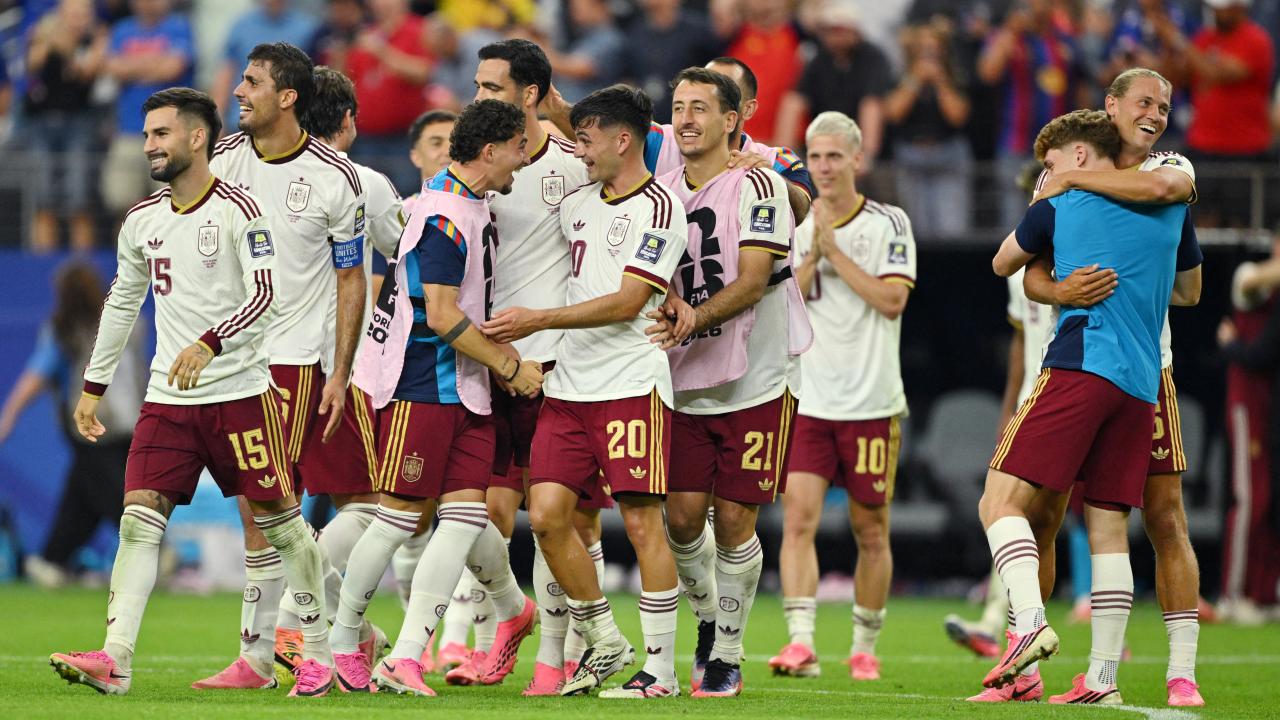
Luis de la Fuente’s men produced a tactical masterclass to defeat France 2-0, booking their place in a first World Cup final since 2010. The scoreline reflected their superiority, but it still failed to capture the scale of Spain’s control over one of the most feared attacking teams in world football.
France was not simply beaten. They were dismantled.
Perhaps no statistic illustrates that domination better than this: France failed to register a shot on target until the 81st minute.
For a team packed with attacking talent, it was a remarkable collapse and a reminder that even the biggest stars cannot shine when the collective structure around them breaks apart.
The African Thread: Morocco’s Indirect Revenge
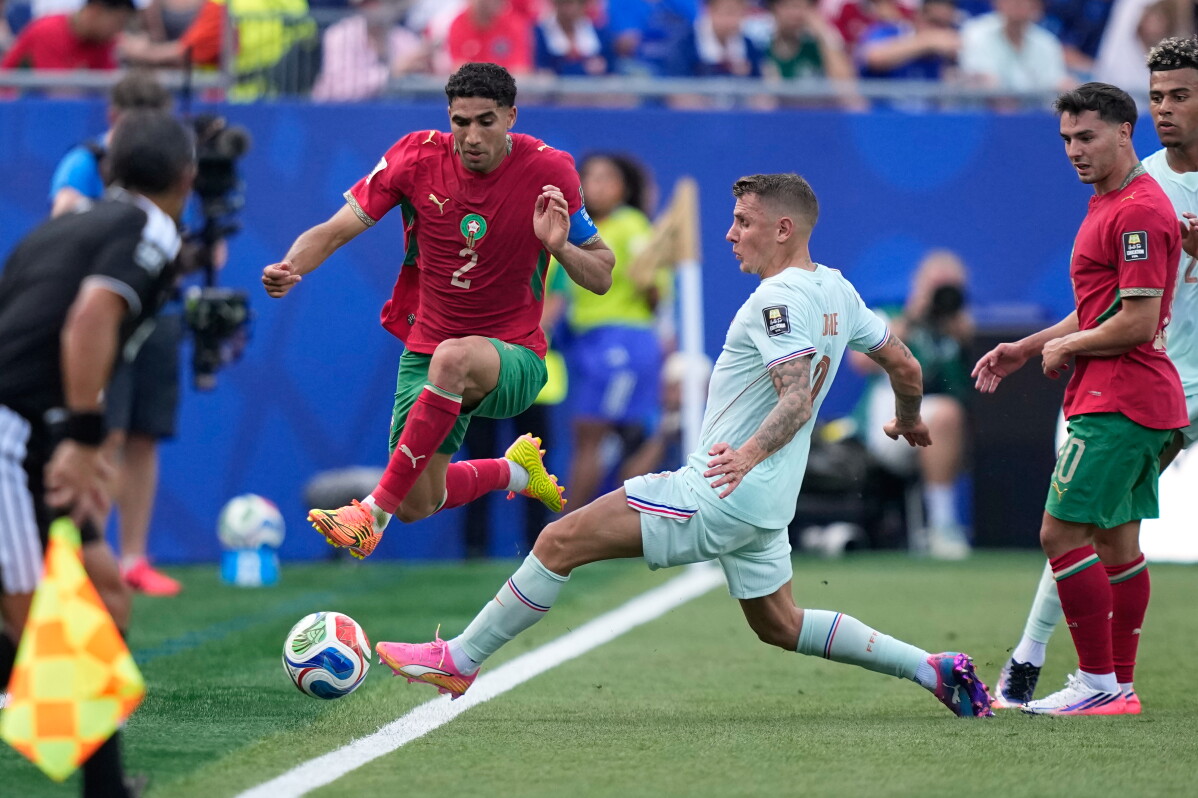
Achraf Hakimi battling for the ball during the FIFA World Cup 2026 quarterfinal match between France and Morocco at Boston Stadium.
Sportxparte has followed Africa’s journey throughout this World Cup, and although no African nation will contest Sunday’s final, the continent’s influence can still be felt in Dallas.
France has twice ended Morocco’s World Cup dreams.
First came the historic semi-final in Qatar 2022, where Les Bleus defeated the Atlas Lions 2-0 despite Morocco producing one of the greatest performances by an African nation at a World Cup.
Four years later, history repeated itself.
France once again eliminated Morocco this time in the quarterfinals of the 2026 World Cup, bringing another remarkable African campaign to an end.
Against Spain, however, France experienced exactly what Morocco had suffered.
Spain monopolised possession. They dictated the rhythm. They denied space, and they forced France to defend for long periods before striking with precision.
The tactical methods were different. France traditionally relies on transitions, physicality, and explosive attacking moments.
Spain depends on patient possession, positional discipline, and intelligent movement.
Yet both approaches arrived at the same destination.
A convincing 2-0 victory. For African football supporters, Tuesday’s result carried an interesting subplot.
The team that twice prevented Morocco from reaching football’s biggest stage was finally outplayed by a side whose collective discipline mirrored many of the principles Morocco themselves tried to implement throughout the tournament.
African football may not be represented in Sunday’s final. Its influence, however, remains impossible to ignore.
France vs Spain: The Most Damning Statistic of the Tournament
Before discussing tactics and before analysing Fabian Ruiz. Before examining Spain’s midfield.
There is one number that defines this semi-final better than anything else. 81 minutes. That was how long France waited before forcing Spain goalkeeper Unai Simón into a save.
Think about the significance. This was a French team that had overwhelmed opponents throughout the competition.
Mbappe, Dembele, Olise, Barcola, and Doue. Together, they formed arguably the most dangerous attacking unit left in the tournament.
Yet against Spain, they barely existed as an attacking force.
France completed long periods without threatening the Spanish goal, spending much of the evening chasing possession instead of creating chances.
That statistic tells a much bigger story than the scoreline itself.
Spain did not merely defend well. They completely dismantled the attacking platform that had allowed France’s stars to flourish during the previous six matches.
Every attacking movement France attempted was disrupted before it could develop.
Every transition was slowed, and every passing lane is closed.
By the time France finally tested Simon in the closing stages, Spain had already established complete control of the contest.
The match was effectively over long before the first shot on target arrived. That is the hallmark of a truly elite tactical performance.
How Spain Suffocated France’s Stars
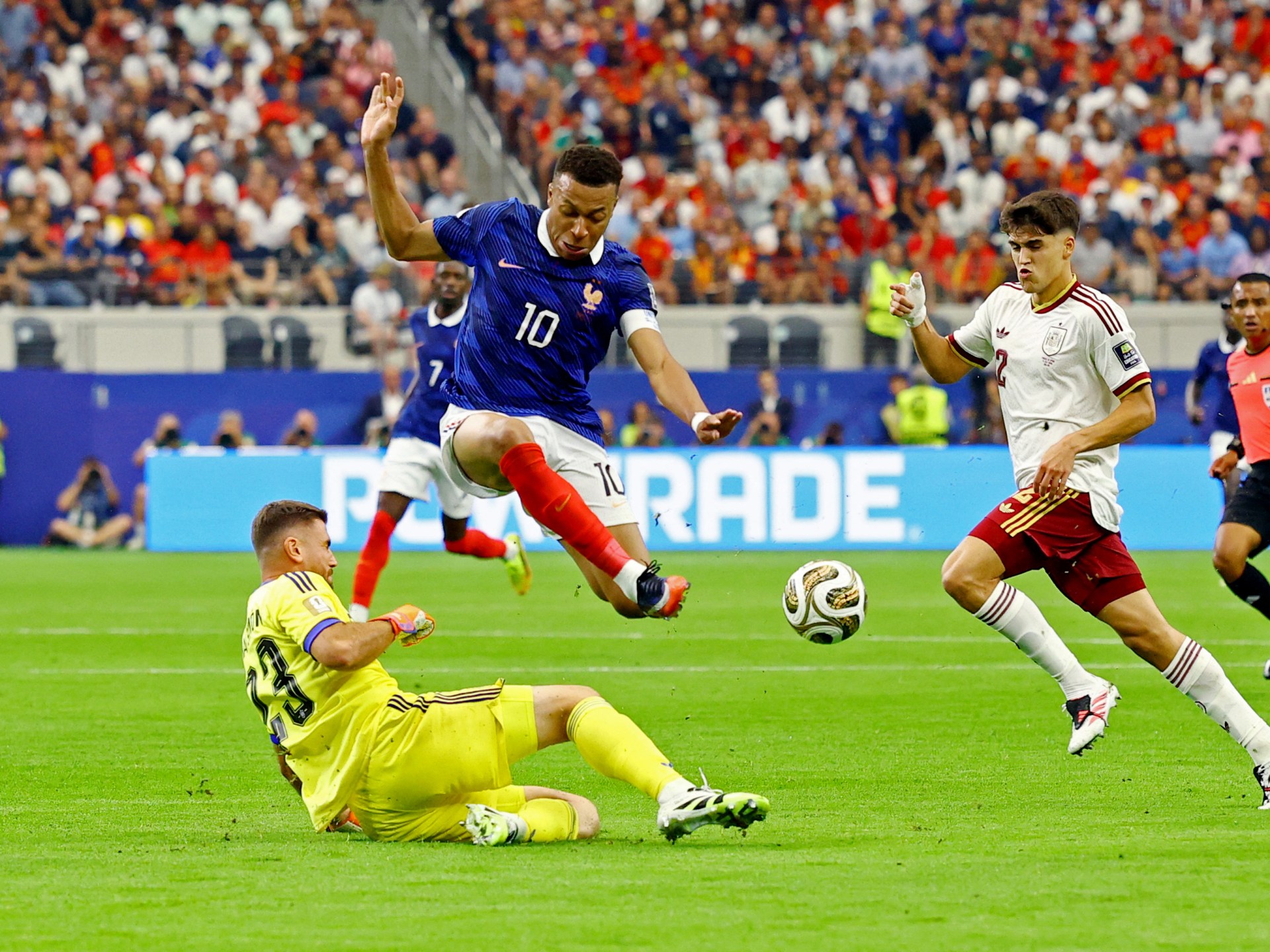
Spain’s goalkeeper Unai Simón (in yellow) blocks and clears the ball away from France’s captain Kylian Mbappé (number 10 in blue) during their 2026 FIFA World Cup semi-final match.
Throughout this World Cup, France often looked like a team waiting for one of its superstars to decide the game.
Mbappe would accelerate into space. Dembele would isolate defenders.
Olise would unlock compact defences with his creativity. Against weaker opponents, that formula worked repeatedly.
Spain refused to let it happen. Rather than assigning one defender to Mbappe or asking individual players to stop France’s stars, Luis de la Fuente designed something much more sophisticated.
He attacked the system instead of the individuals.
Spain controlled possession with extraordinary patience, moving France from side to side until gaps appeared.
Every pass had purpose. Every movement supported the next.
Whenever France regained possession, they immediately found themselves surrounded by Spanish shirts.
The midfield offered no time to turn. The forwards received almost no service.
And the spaces Mbappe normally attacks simply disappeared.
Without possession, France’s attackers became isolated. Without space, they lost their greatest weapon speed. And without rhythm, even players of Mbappe’s quality struggled to influence proceedings.
Spain did not stop one French superstar.
They stopped all of them simultaneously. That is what separates elite tactical teams from merely talented ones.
France entered the semi-final believing individual brilliance would eventually provide another solution.
Spain removed every opportunity for that brilliance to appear.
By the final whistle, one lesson stood above everything else. At football’s highest level, even the world’s greatest forwards become ordinary when the collective around them ceases to function.
Vieira’s Devastating Verdict When France’s Stars Had No Answers
When the final whistle sounded in Dallas, there was little room for excuses. France had been second best in every meaningful phase of the game, and few people summed up that disappointment better than World Cup winner Patrick Vieira.
The former France captain did not focus on one mistake or one individual. Instead, he pointed to something much deeper.
”There was a lot of expectation that France would win the World Cup. We are all very disappointed with the result, but especially with the performance, because we needed our best players to play well today, and they couldn’t do it.
”It was not just one or two who didn’t show up; all of them didn’t. Collectively, we were very poor.”
Those words carry enormous weight because they come from someone who understands exactly what winning football’s biggest prize demands. Vieira was part of the legendary France side that conquered the world in 1998, and his assessment reflected the reality of Tuesday’s semi-final.
It would be unfair to single out Kylian Mbappe, Ousmane Dembele, or Michael Olise. None of them were given the platform to influence the contest. Spain’s relentless pressing, superior midfield control, and intelligent positional play meant France rarely enjoyed sustained possession in dangerous areas.
Whenever Mbappe received the ball, he was immediately surrounded. Dembele found himself isolated against multiple defenders, while Olise was repeatedly forced to collect possession far away from the penalty area.
France’s biggest attacking weapons spent more time chasing the game than controlling it.
Throughout this World Cup, the French story had been built around individual brilliance. Time and again, one moment from Mbappe or Dembele had rescued difficult situations.
Against Spain, however, those moments never arrived.
The semi-final demonstrated a truth that every successful international side eventually learns, individual quality can only flourish when the collective structure functions properly.
France’s structure collapsed. Spain made sure of it.
France vs Spain: The Fabian Ruiz Decision, Luis de la Fuente’s Boldest Gamble
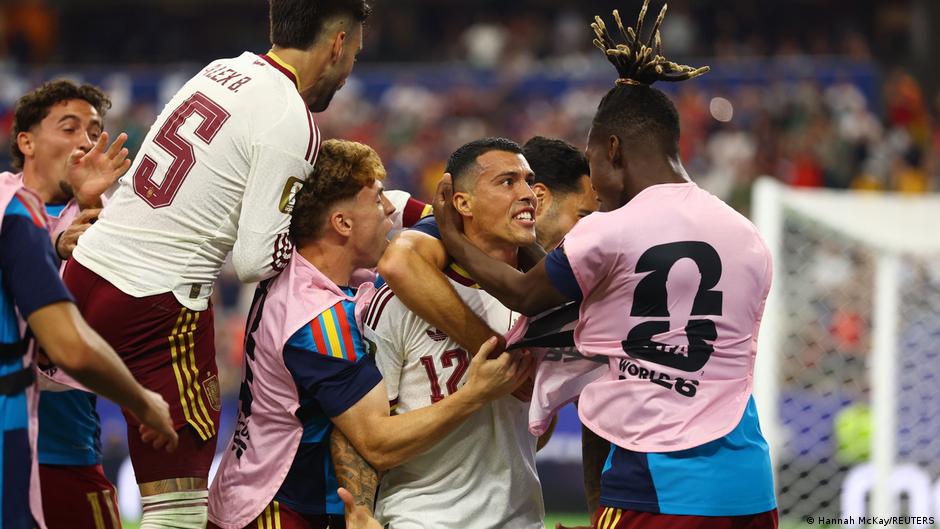
Spain’s Pedro Porro is celebrating his 2026 World Cup semifinal goal vs France.
Perhaps the most fascinating tactical story of the semi-final happened before a ball was even kicked.
For the second consecutive knockout game, Spain manager Luis de la Fuente left Pedri on the bench.
For many coaches, that decision would have been unthinkable.
Pedri is widely regarded as one of football’s finest midfield technicians. His positional intelligence, vision, and ability to dictate the rhythm of matches make him one of Barcelona’s most valuable players and a cornerstone of Spain’s future.
Yet De la Fuente saw something different.
Against Belgium in the quarter-finals and again against France, he believed Fabian Ruiz offered exactly what Spain needed.
The gamble paid off spectacularly. Standing at 1.89 metres, Ruiz brought physical authority without sacrificing technical quality. Against France’s powerful midfield trio of Aurelien Tchouameni, Adrien Rabiot, and Michael Olise drifting inside, Spain needed someone capable of matching strength with intelligence.
Ruiz delivered one of the finest midfield performances of the tournament. He recovered possession seven times, won five of his six defensive duels, and committed only one foul despite constantly engaging France’s dangerous attackers.
Those numbers alone underline how dominant he was defensively. His influence with the ball was equally impressive.
Ruiz completed 22 ball carries covering 163 metres, with 71 metres classified as progressive movement. Whenever France attempted to press aggressively, Ruiz simply drove through the pressure, breaking lines and allowing Spain to advance up the pitch.
Before leaving the field in the 78th minute, he recorded 83 touches more than every Spain outfield player except Aymeric Laporte, who played the entire match.
His performance showed why tactical flexibility often wins major tournaments. Pedri remains one of Spain’s greatest creative talents.
But against France, Fabian Ruiz was exactly the midfielder they needed. Sometimes football’s hardest decisions become the most important ones.
Rodri and Dani Olmo: The Midfield That Won Spain a World Cup Final Place
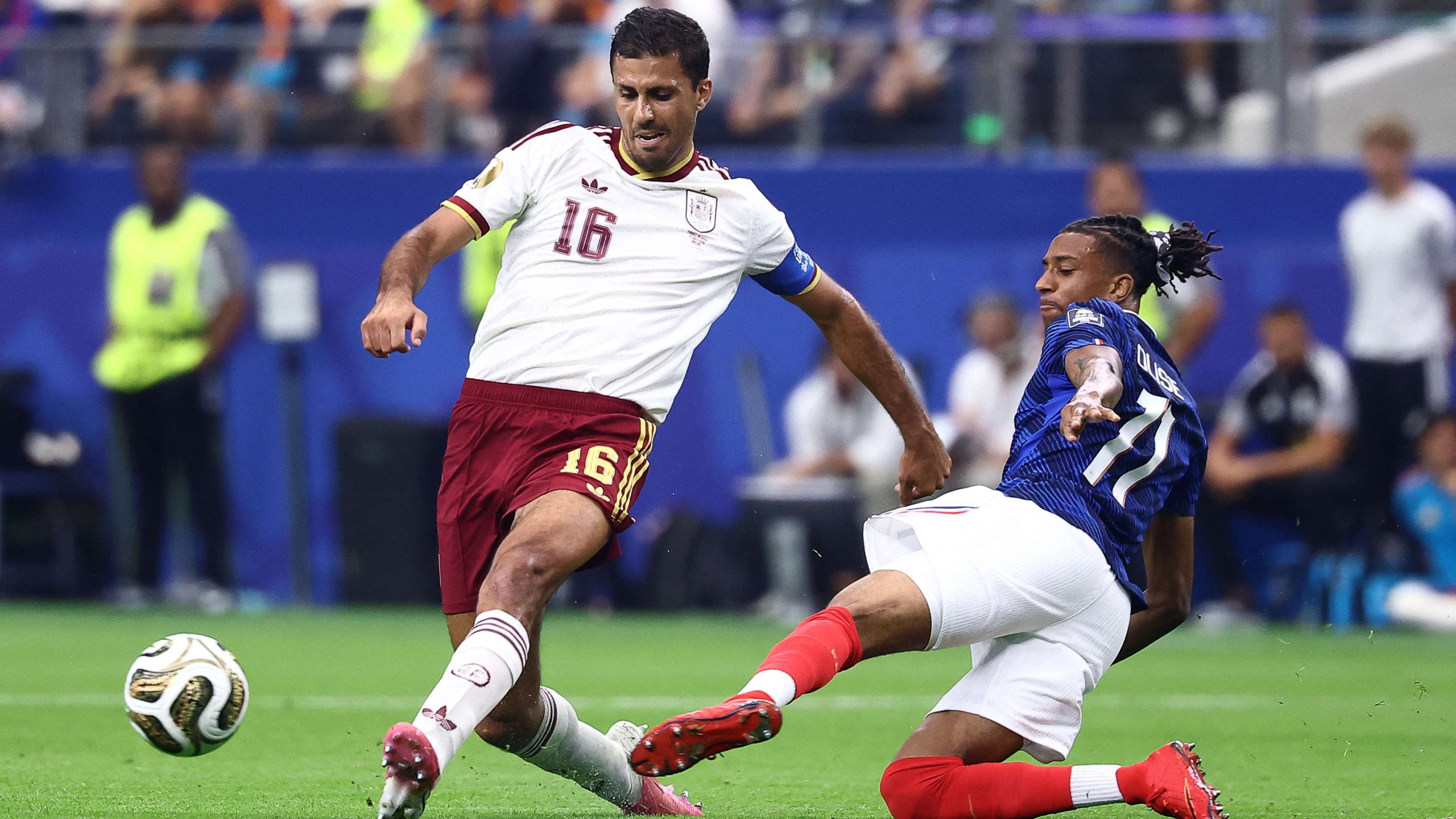
French forward Michael Olise is making a dangerous sliding tackle on Spain’s captain and midfielder Rodri.
Fabian Ruiz was exceptional, but he did not dominate alone. Spain’s midfield functioned because each player understood a completely different responsibility.
Rodri provided the platform. Ruiz supplied the balance. Dani Olmo delivered the creativity.
Rodri once again reminded everyone why he is regarded as the world’s best holding midfielder.
His reading of danger, positional discipline, and calm distribution allowed Spain to maintain complete control whenever France attempted to counterattack.
Against one of the quickest attacking teams in international football, Rodri won seven of his 12 individual duels and dominated all four aerial contests.
Every successful Spanish attack seemed to begin with Rodri calmly recycling possession before finding the right passing lane.
Alongside him, Fabian Ruiz added athleticism and physical presence. Then came Dani Olmo.
Unlike a traditional number ten, Olmo constantly drifted across the pitch searching for space. Sometimes he dropped alongside Rodri to help Spain build attacks.
At other moments, he moved between France’s midfield and defensive lines, forcing defenders into impossible decisions.
Whenever Mikel Oyarzabal vacated the central striker’s position, Olmo instinctively filled the gap. When Lamine Yamal drifted inside, Olmo widened his position.
When France pressed high, Olmo became another passing outlet deep in midfield. His movement created constant uncertainty.
That intelligence played a decisive role in Spain’s second goal.
Olmo initially dropped between the centre-backs to receive possession, drawing France’s midfield out of shape before helping launch the move that eventually led to Pedro Porro doubling Spain’s advantage.
It was a perfect example of Spain’s philosophy. Every player understood not just his own role but everyone else’s as well.
That collective understanding overwhelmed France. The contrast could hardly have been clearer. France relied on individual stars to solve problems.
Spain relied on a midfield functioning as one perfectly synchronised unit.
On the biggest stage in world football, the collective proved stronger than individual brilliance.
And that collective has now carried Spain into their first World Cup final since 2010.
France vs Spain: What This Means for Deschamps’ Legacy
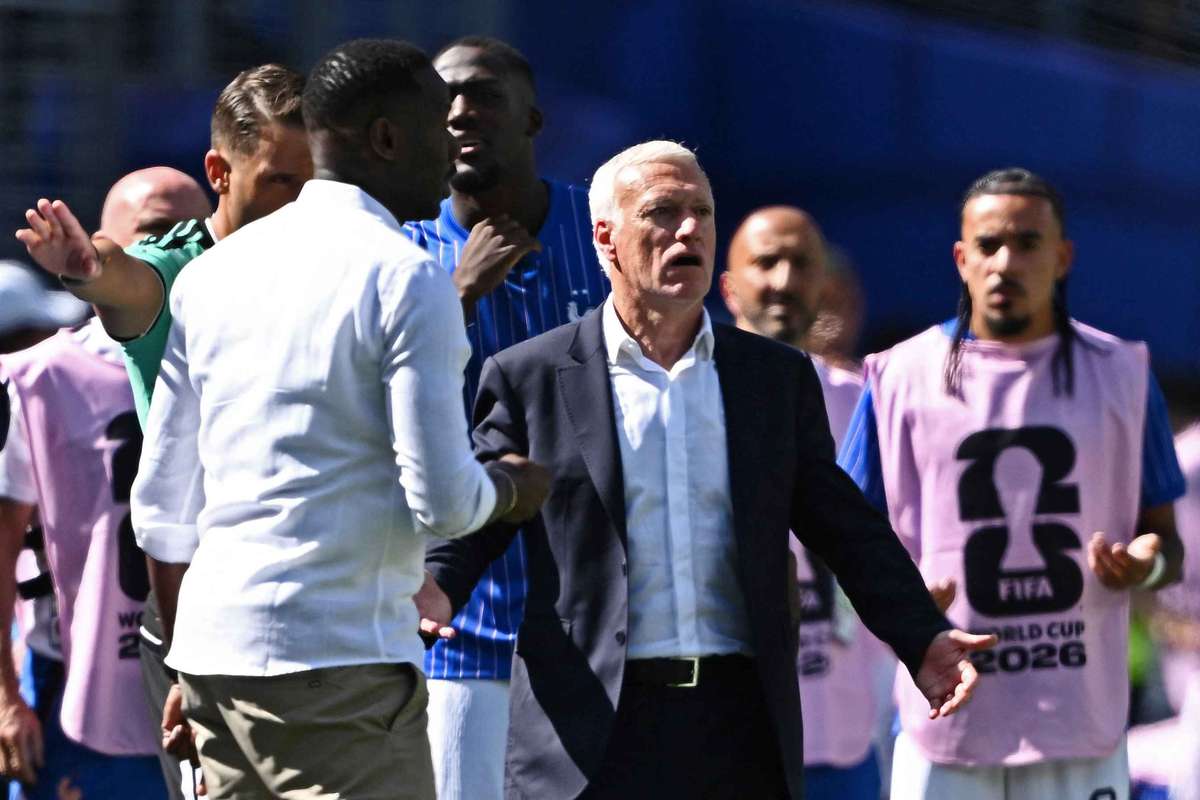
France head coach Didier Deschamps and Senegal head coach Pape Thiaw reacting on the touchline during a match.
Tuesday’s defeat in Dallas will inevitably become part of the conversation around Didier Deschamps’ remarkable tenure as France manager.
It was his 26th World Cup match in charge, taking him past Helmut Schön’s record and underlining just how consistent France has been under his leadership. Since taking over in 2012, Deschamps has delivered a World Cup title in 2018, a runners-up finish in 2022, and now a semi-final appearance in 2026.
Few international managers can match that record. Yet football often remembers endings as vividly as triumphs.
France arrived in the United States as one of the favourites to lift the trophy. Their attack looked irresistible, with Kylian Mbappé, Ousmane Dembélé, Michael Olise, Bradley Barcola, and Désiré Doué overwhelming opponents throughout the tournament. But against Spain, that attacking power simply disappeared.
Patrick Vieira’s post-match assessment perfectly summed up the mood.
”There was a lot of expectation that France would win the World Cup. We are all very disappointed with the result.
”But especially with the performance, because we needed our best players to play well today, and they couldn’t do it. It was not just one or two who didn’t show up; all of them didn’t. Collectively, we were very poor.”
Those words carried enormous weight coming from a World Cup winner who understands exactly what these occasions demand.
The defeat was not caused by one misplaced pass or one defensive mistake. Spain dismantled France collectively.
Their midfield dictated every phase of the game, their pressing denied France any rhythm, and their positional discipline left Mbappé and company isolated.
Deschamps leaves behind one of the greatest managerial legacies in French football history. But his final World Cup will also be remembered as the tournament where a superior collective finally exposed the limits of individual brilliance.
Spain in the Final: The Most Complete Team at This World Cup
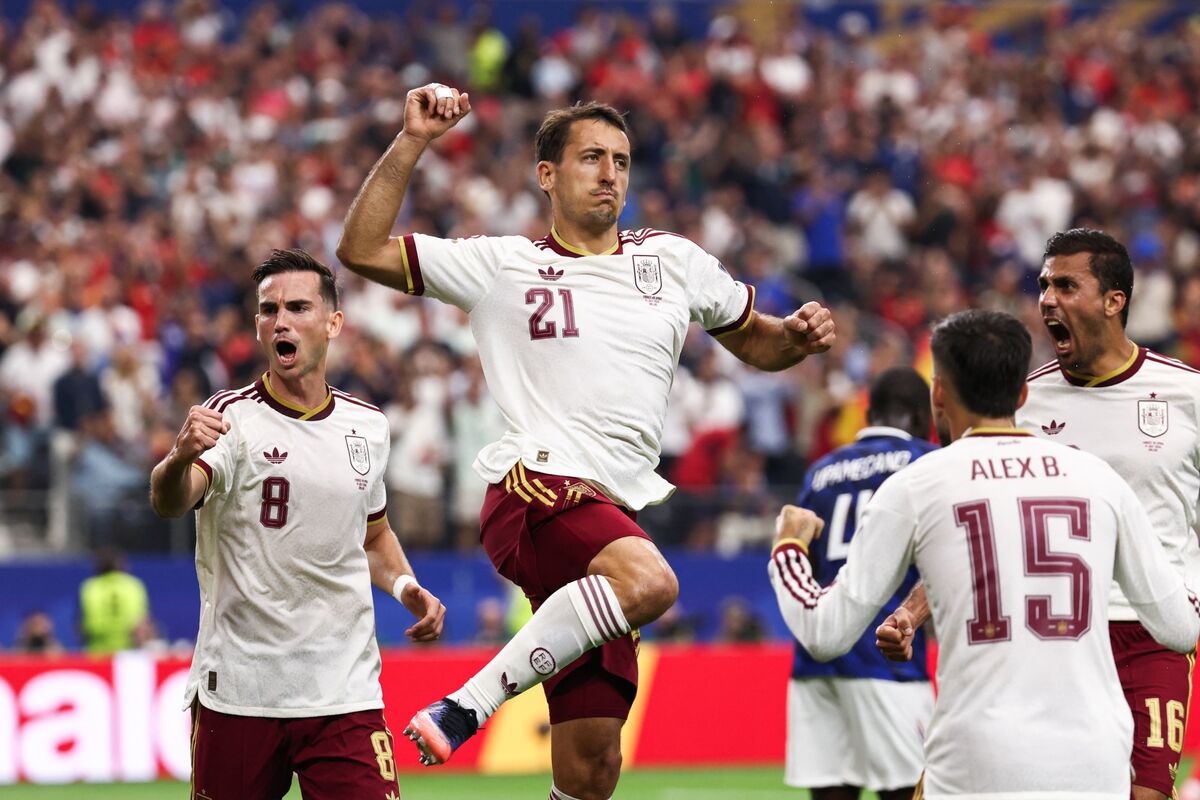
Spain national football team forward Mikel Oyarzabal (number 21) celebrates his opening goal from the penalty spot against France in the 2026 FIFA World Cup semi-final at Dallas Stadium in Arlington, Texas.
Spain is now one match away from lifting their second FIFA World Cup trophy.
More importantly, they have earned that opportunity by playing the most complete football of any team at the tournament.
Unlike many of their rivals, Spain has not depended on one superstar to carry them through difficult moments. Every knockout victory has reinforced the same philosophy: collective organisation over individual inspiration.
Against France, that philosophy reached its highest level. Rodri controlled the tempo.
Fabian Ruiz dominated both physically and technically. Dani Olmo floated intelligently between the lines.
Lamine Yamal stretched France’s defence with fearless running. Oyarzabal sacrificed personal glory to create space for teammates.
Even defenders like Cucurella, Cubarsí, and Laporte contributed to Spain’s attacking build-up without compromising their defensive structure.
Every player understood his role. Every movement had a purpose.
That collective understanding explains why Spain controlled one of the world’s most dangerous attacking teams for almost the entire match.
France’s first shot on target arrived in the 81st minute.
That statistic alone explains why Spain deserves to be playing in Sunday’s final.
Whether England or Argentina emerges from the second semi-final, they will face a Spanish side playing with supreme confidence, tactical clarity, and remarkable unity.
For Luis de la Fuente, whose bold decisions, particularly leaving Pedri on the bench in consecutive knockout games, were heavily questioned, Tuesday was complete vindication.
He trusted the system over reputation. The system rewarded him with a place in the World Cup final.
France vs Spain: Verdict
France travelled to the United States with arguably the most gifted collection of attacking players at the tournament.
Spain travelled with something even more valuable. A system.
On Tuesday night in Dallas, the difference between those two ideas became impossible to ignore.
Mbappé, Dembélé, and Olise had thrilled supporters throughout the tournament, but football’s biggest occasions demand more than moments of brilliance. They demand a collective capable of surviving pressure, controlling matches, and finding solutions when individual quality alone is no longer enough.
Spain provided every one of those qualities. Fabian Ruiz justified Luis de la Fuente’s biggest tactical gamble.
Rodri once again demonstrated why he remains the heartbeat of this team.
Dani Olmo’s freedom between the lines continually destabilised France’s defensive shape.
Most importantly, every Spanish player worked as part of a single, perfectly synchronised mechanism.
From an African perspective, there is another lesson worth remembering. Morocco showed four years ago that organisation, discipline, and belief can challenge the world’s traditional powers. Spain has now taken those principles to another level, proving that tactical cohesion can still overcome squads filled with global superstars.
France’s stars never found the platform to shine. Spain never allowed them one. The result was inevitable.
Spain is back in the FIFA World Cup final for the first time since 2010, and after eliminating one of the tournament favourites with such authority, few would argue they have not earned their place.